
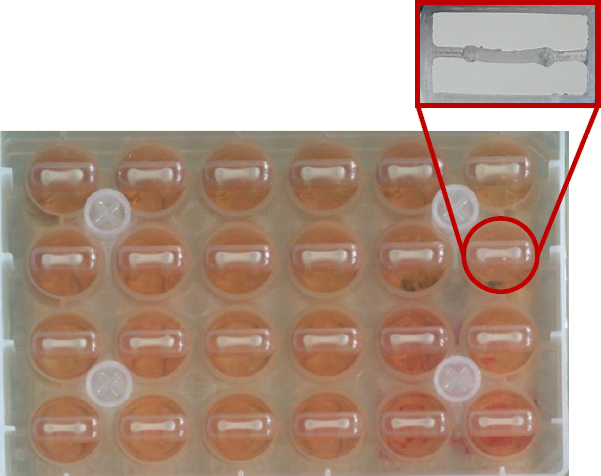
This poster is being hosted on this website in its raw form, without modifications. It has not undergone peer review but has been reviewed to meet AZoNetwork’s editorial quality standards. The information contained is for informational purposes only and should not be considered validated by independent peer assessment. Contracted research Screening of drug candidates and other compounds on muscle organs to generate toxicity and efficacy data. Research and development Development of bespoke assays to enable drug discovery against specific modalities including disease, injury and rehabilitation. Image Credit: Myomaker Bio Muscle organs 3D human-derived muscle organs Designed for bespoke preclinical assays Organs are cultured in multi-well plate format Validation of pharmaceutical agents including: Barium Chloride Leucine d-tubocurarine Insulin Resolvin E1 (RvE1) Testosterone Organ cell types: Human: Primary, cell line and iPSC Animal Rodent (rat, mice) Small mammal (rabbit) Other: Zebra Fish Myomaker organ 1: Chemical injury has been modelled using barium chloride, cardiotoxin and tubocurarine. Barium chloride ablates muscle fibres (left), this injury is followed by regeneration. Image Credit: Myomaker Bio Neuromuscular organs Skeletal muscle organ with functional neuromuscular junctions Demonstrated by pre- and post synaptic colocalization Image Credit: Myomaker Bio Myomaker organ 2: Spontaneous twitch in muscle organs with iPSC motor
Read More
Custom screening strategies for complex muscle organs – News-Medical.Net
Custom screening strategies for complex muscle organs – News-Medical.Net