
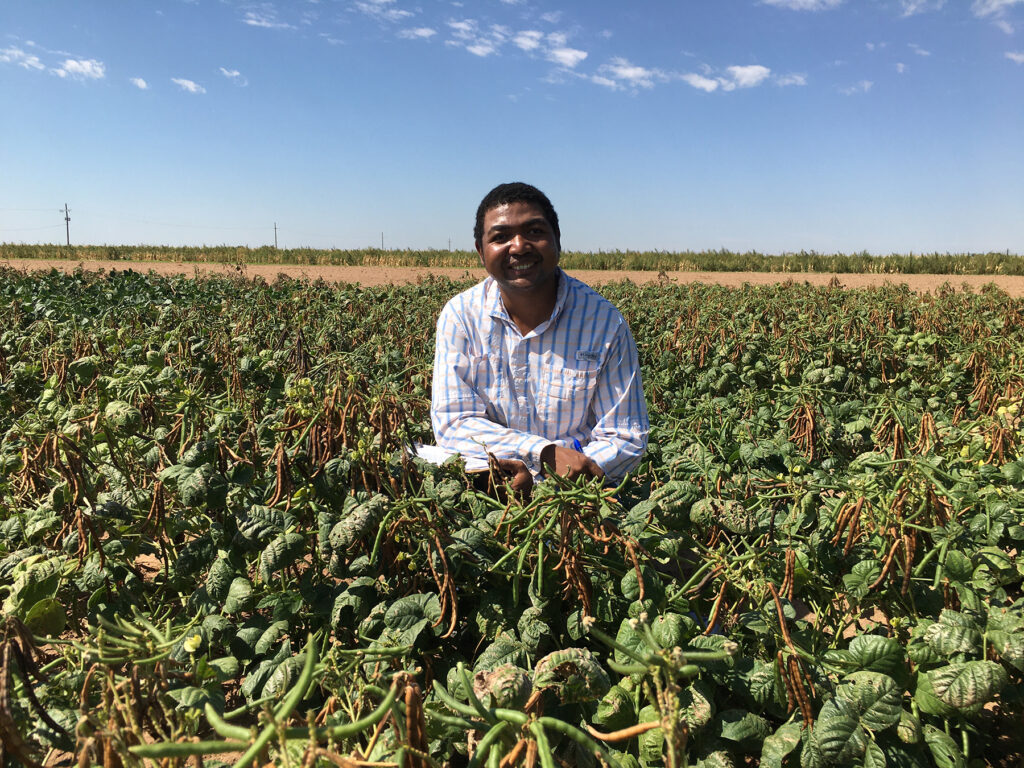
Mung beans might be absent from many menus across the U.S., but Texas A&M AgriLife Research and AgriVentis Technologies are investigating the potential of this alternative protein source. Waltram Ravelombola, Ph.D., a Texas A&M AgriLife Research organic and specialty crop breeder in Vernon, is conducting variety trials for mung beans across Texas. (Texas A&M AgriLife photo) Mung beans are a legume that is good for both the body and the soil, but few are currently grown in the U.S. A small acreage exists in Texas, Oklahoma and California, but a growing market is prompting larger interest in finding varieties that will flourish throughout Texas. Mung beans offer health and environmental benefits to producers who introduce them into their cropping systems, said Waltram Ravelombola, Ph.D., an AgriLife Research organic and specialty crop breeder at the Texas A&M AgriLife Research and Extension Center at Vernon and the Texas A&M Department of Soil and Crop Sciences. AgriVentis approached Ravelombola and AgriLife Research about conducting variety trials for their mung beans to measure their adaptation to Texas production. “Mung bean is a legume that provides a high-quality protein for humans, and it also helps farmers diversify a producer’s crop rotation,” Ravelombola said. “They can be double
Read More
Texas A&M AgriLife Research breeder explores adapting mung beans for Texas
Texas A&M AgriLife Research breeder explores adapting mung beans for Texas