
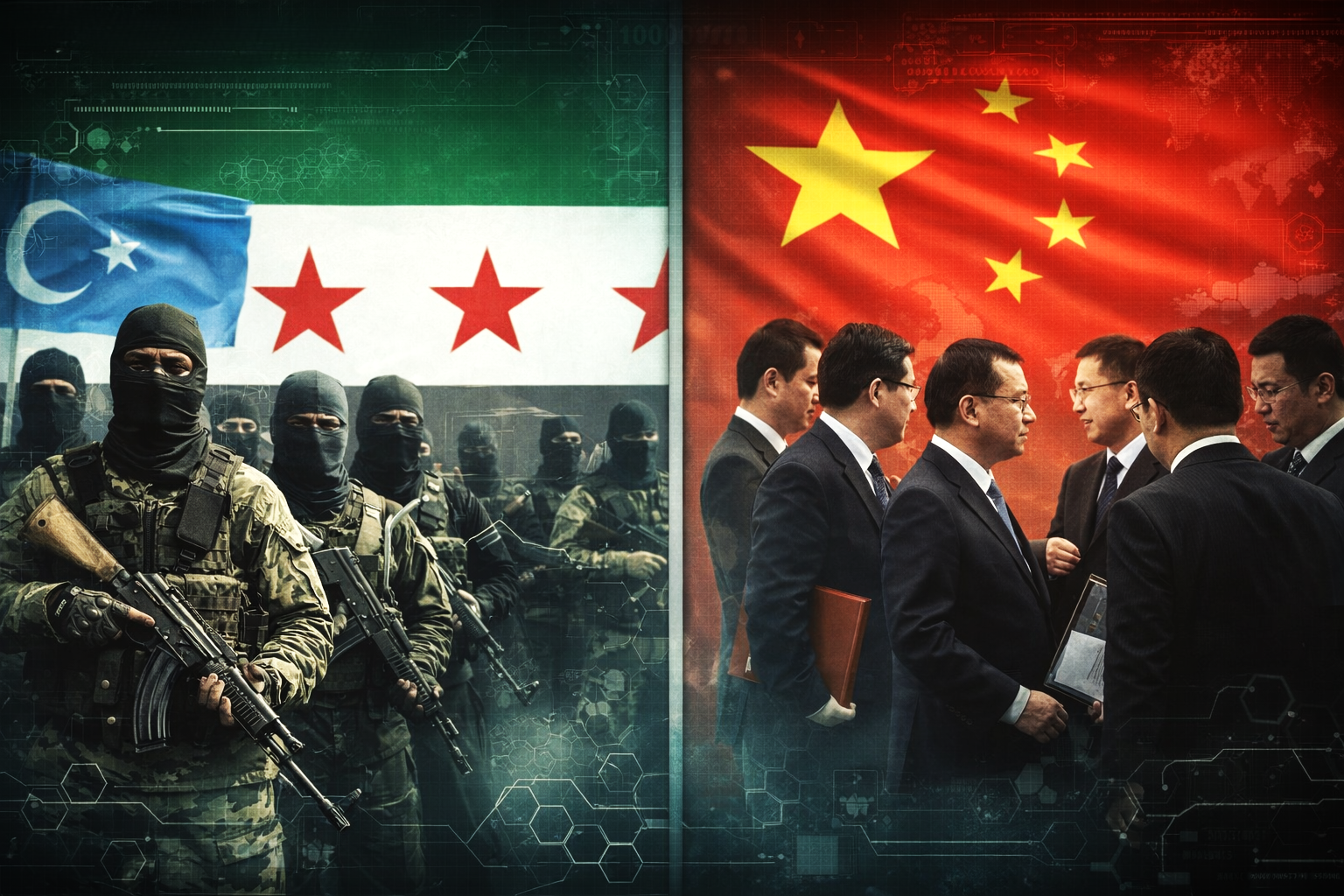
Executive Summary The Syrian Civil War remains one of the most protracted conflicts in the Middle East, with ramifications extending across regional and international theatres. Crucially, state and non-state actors have exploited prevailing instabilities to advance specific political agendas. Notable among these are Uighur militants. The de facto Syrian regime is allegedly aiming to incorporate these individuals into its developing military structure. This report assesses how the institutionalisation of Uighur fighters within the new Syrian political framework affects Chinese strategic interests in both the Levant and Central Asia. Key Points The Uighur insurgency undermines Chinese domestic security and international strategic objectives. Central Asian militant movements are incrementally expanding their operational reach beyond traditional borders. The regularisation of transnational insurgents within the Syrian state apparatus raises significant concerns regarding the reliability of the Al-Sharaa administration. Background Information The Syrian conflict represents a significant theatre within the broader Middle East that adopted a pronounced jihadist character at specific operational phases. Beyond the period of the self-styled Islamic State caliphate, which projected influence globally, various Islamic factions engaged in hostilities to secure political primacy. Ahmad al-Sharaa, formerly of al-Nusra and Hayat Tahrir al-Sham (HTS), effectively neutralised the degraded army forces of the Assad
Read More
Uighur Militancy in Syria and Its Impact on China’s Ambition – SpecialEurasia
Uighur Militancy in Syria and Its Impact on China’s Ambition – SpecialEurasia