
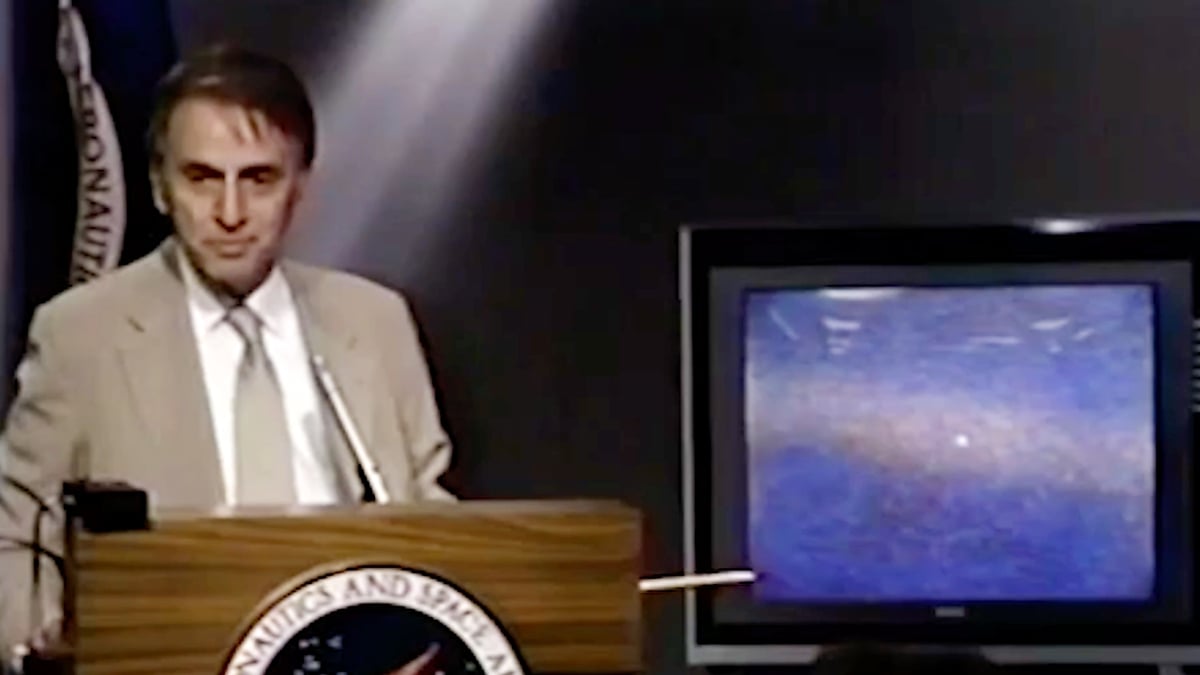
Look closely at one of the most famous photographs ever taken of Earth and you might struggle to find Earth at all. There are no blue oceans. No continents. No clouds. Just darkness, scattered sunlight, and a tiny pale blue point almost lost within it. That dot is us. The photograph was taken 36 years ago on Valentine’s Day by NASA’s Voyager 1. Voyager 1 was launched in 1977 to study Jupiter and Saturn. By 1990, NASA was preparing to switch off its cameras permanently to conserve the spacecraft’s limited power. But before the cameras went dark, there was one last idea. Astronomer Carl Sagan, a member of the Voyager imaging team, had spent years arguing that the spacecraft should turn around and photograph the Solar System it was leaving behind. Carl Sagan unveils the Pale Blue Dot in 1990. (The Planetary Society/Vimeo) So on February 14, 1990, Voyager captured 60 frames for a Solar System ‘family portrait’. Earth appeared in one of them. From around 6.4 billion kilometers (4 billion miles) away, our entire planet occupied just 0.12 of a pixel. The bright band crossing the image was sunlight scattered inside the camera’s optics. Earth happened to fall within one of those rays. The
Read More

Monday, August 24, 2026

Monday, August 24, 2026
Voyager 1 Took a Final Look Back at Earth 36 Years Ago. Today It’s More Relevant Than Ever.

ADVERTISEMENT
- Trending
- Comments
- Latest







We bring you the best news, updates, reviews, and events coverage surrounding the worlds top Social Network Companies.
