
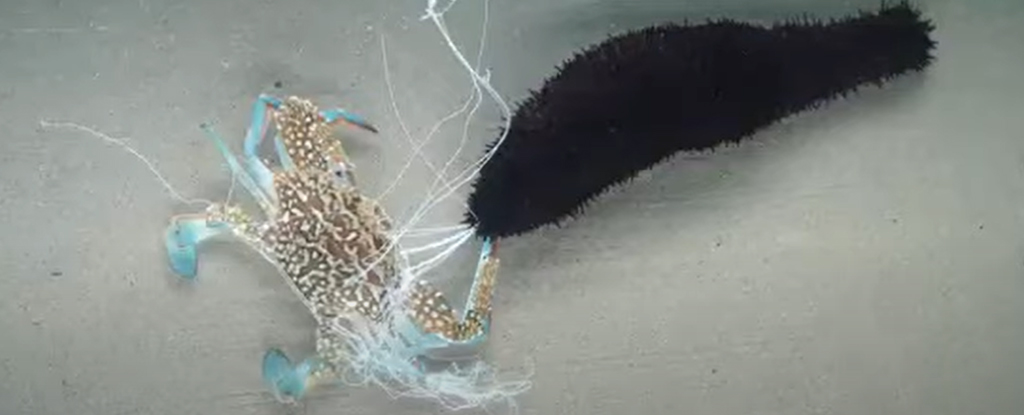
(T. Chen et al., PNAS 2023) Squirming slowly along the ocean floor, sea cucumbers look like an easy target to hungry predators. But at the slightest provocation, these chunky tube animals tear a hole in the wall of their own butt and cast out a tangle of fine, sticky, noodles.Stress-induced butt-vomiting might sound comical, but it serves a useful purpose – the eviscerated organs of some sea cucumbers (like the black sea cucumber, Holothuria leucospilota) can entangle and neutralize predators. frameborder=”0″ allow=”accelerometer; autoplay; clipboard-write; encrypted-media; gyroscope; picture-in-picture; web-share” allowfullscreen>According to a new study, the expellable innards – called Cuvierian organs – are composed of proteins similar to spider silk.First described in 1831, the Cuvierian organ has hundreds of tubules that dangle from the base of the sea cucumber’s breathing organ called a respiratory tree (these animals also breath through their butts). Their far ends float freely within the fluid of the sea cucumber’s body cavity.A related species with its Cuvierian organ out. (Rpillon/Wiki/CC BY-SA 3.0)”[S]timulus-selective response in H. leucospilota may be turned on only when an encroaching predator exerts a sufficiently large physical force directly onto the Cuvierian organ,” the researchers explain.They traced the molecular pathway that triggers the organ’s
Read More

Monday, October 5, 2026

Monday, October 5, 2026
Sea Cucumbers Shoot a Weird, Sticky Organ From Their Butt to Fight Off Predators

ADVERTISEMENT
- Trending
- Comments
- Latest






We bring you the best news, updates, reviews, and events coverage surrounding the worlds top Social Network Companies.
