
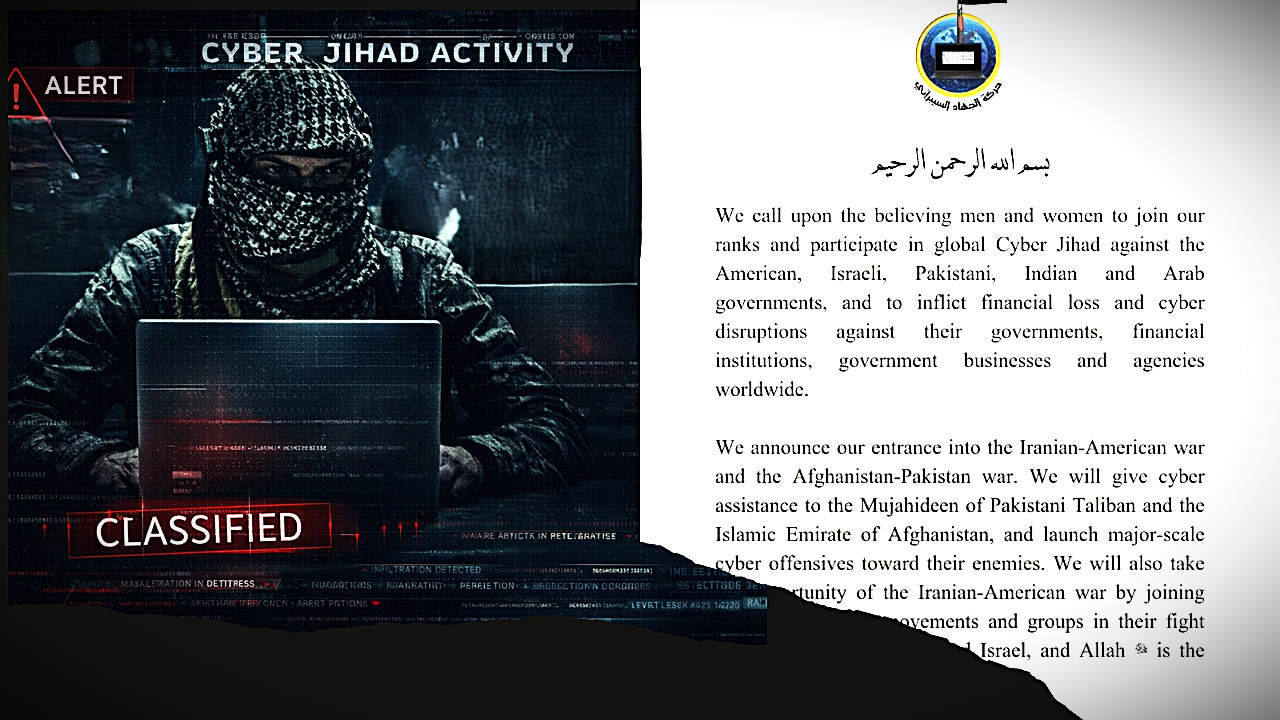
Executive Summary The recent manifesto by the Cyber Jihad Movement (CJM), an al-Qaeda affiliate, signals a strategic shift toward digitised attrition against Eurasian regional state infrastructures. The manifesto coincides with a severe degradation of security across the AfPak border and the start of the war between the United States, Israel and Iran. Al-Qaeda’s strategic aim to coordinate cyber-attacks with active regional hostilities elevates the probability of systemic instability across financial and governmental domains. The convergence of non-state hacker collectives with established terrorist organisations suggests a transition toward integrated hybrid warfare that exploits existing geopolitical instabilities. Key Takeaways The Cyber Jihad Movement has formally declared its entry into the Iran-US and Afghanistan-Pakistan conflicts to provide technical support to the Taliban and pro-Iranian proxies. Pakistan’s “Ghazab Lil-Haqq” military operation against the Taliban has catalysed a unified front between the TTP and the Afghan Taliban, increasing the risk of domestic insurgent penetration. Terrorist strategic objectives have pivoted toward “economic terrorism,” prioritising the disruption of global financial systems and foreign investment over localised kinetic strikes. Background Information On 4 March 2026, the Cyber Jihad Movement (CJM) released an English-language manifesto calling for global participation in digital sabotage against the United States, Israel, India, Pakistan
Read More

Saturday, September 19, 2026

Saturday, September 19, 2026
Global Cyber Jihad and Multi-Front Hybrid Threats – SpecialEurasia

ADVERTISEMENT
- Trending
- Comments
- Latest






We bring you the best news, updates, reviews, and events coverage surrounding the worlds top Social Network Companies.
